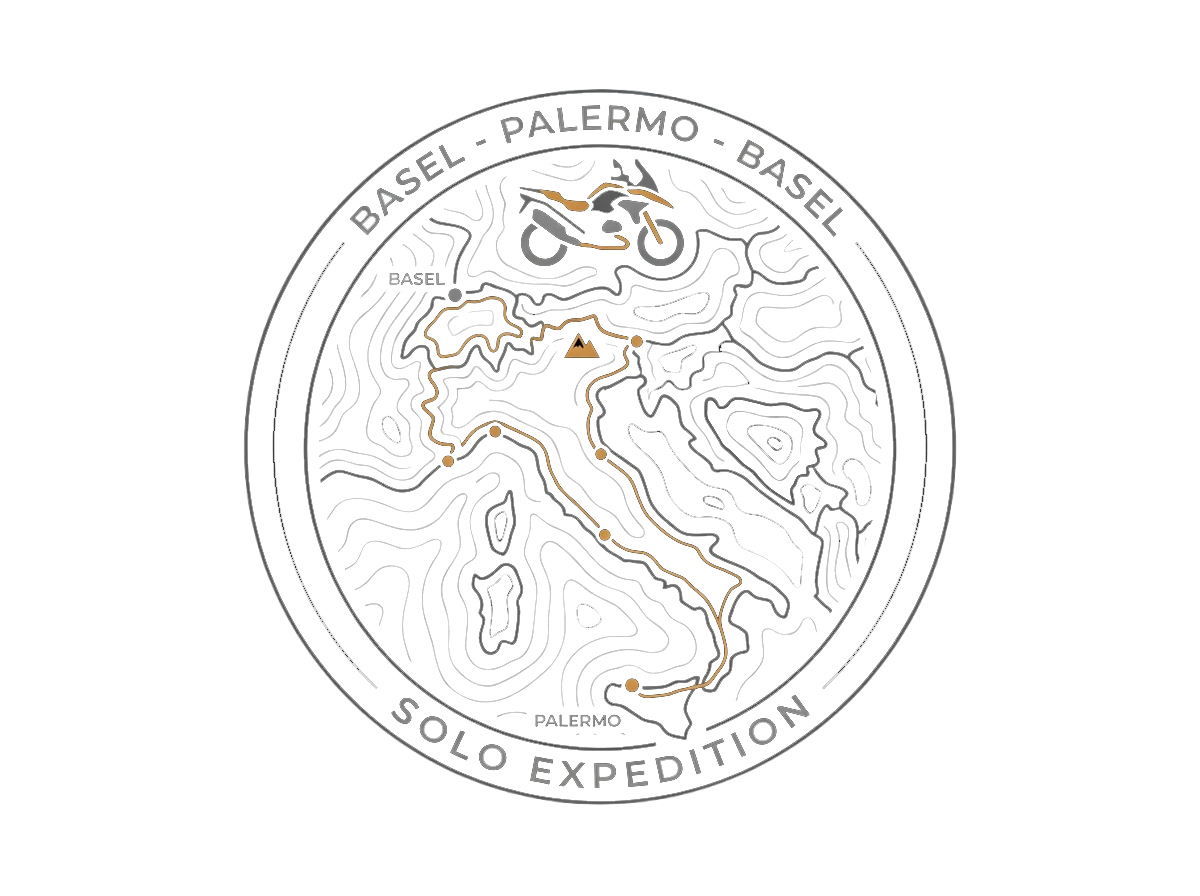
From Greek temples in Agrigento to the rough inland roads of Corleone and Camporeale, today became a ride through Sicily’s deeper layers of history and identity. After dust, detours, and disappearing roads, the expedition ended in Palermo with a family reunion beside the cathedral and UNESCO heart of the city.
Sicily kept changing character today.
The morning began in Agrigento at the Valley of the Temples — one of those places that completely resets perspective. Massive Greek temples standing above the Mediterranean, older than most people instinctively realize. Long before Rome dominated the island, Sicily was deeply tied to Magna Graecia, the network of Greek colonies spread across southern Italy. What remains in Agrigento is not ruin in the usual sense; it is scale, geometry, and continuity. Columns still standing after more than two thousand years under the Sicilian sun.
Then the road changed completely.
The coast disappeared and the expedition moved inland toward Corleone. The further away from the sea, the rougher and more uncertain the roads became. “Road” occasionally became an optimistic term. Broken surfaces, gravel sections, disappearing connectors, and stretches where the route felt closer to a suggestion than infrastructure. More than once I wondered whether turning around would have been the smarter option.
But Corleone had to be visited.
Not because of tourism clichés, but because Sicily carries its stories directly in the landscape. The name exists far beyond the island because of fiction, but the terrain itself explains why power once concentrated in places like this: isolated hills, difficult access, strong local identity, and a geography built around control of movement.
From there the route pushed further toward Camporeale — the roots of Don Carlo Rizzuto’s family. At that point the day had already become physically and mentally demanding. Heat, rough roads, navigation uncertainty, and long hours inland started stacking together. Still, the bike kept moving. Sometimes slowly, sometimes questioning the route entirely, but always forward.
By evening, Palermo finally appeared.
The contrast was immediate. After remote inland Sicily came density, noise, movement, architecture, and history layered on top of itself. The family-style B&B sits only fifty meters from Palermo Cathedral and the UNESCO-listed Arab-Norman heritage zone — one of the clearest reminders that Sicily was never culturally singular. Greek, Arab, Norman, Spanish, Italian — the island absorbed everything and turned it into its own identity.
Tonight the expedition pauses in the middle of that history.
Dusty roads behind. Palermo alive outside the window. And somehow, despite the terrain, the wrong turns, and the disappearing roads, the machine made it all the way through.