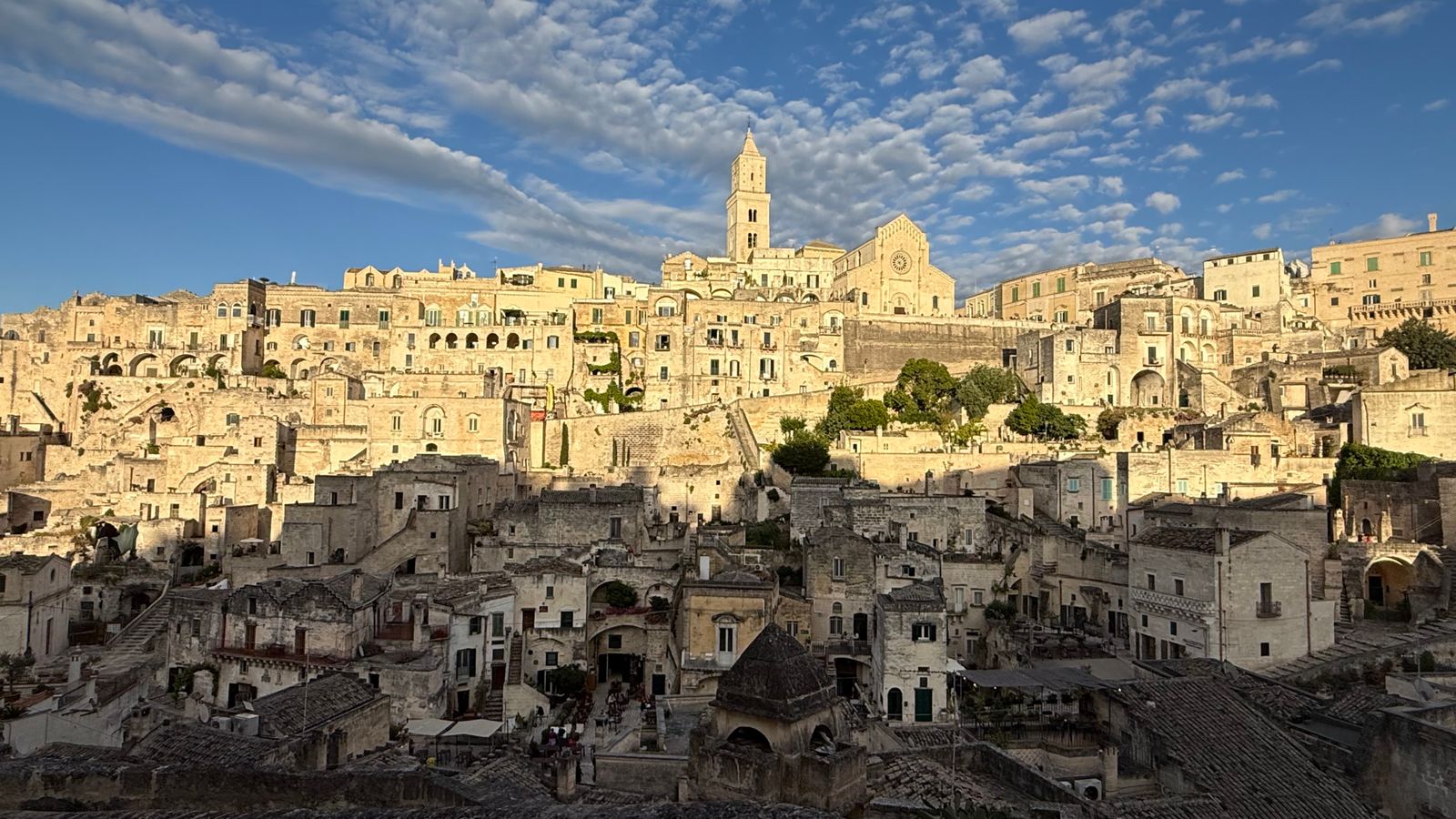
No riding today — only full immersion into Matera’s ancient stone city. A rare expedition day where the motorcycle disappeared into the background and the destination became the story.
A Day Inside Matera
After days of movement, engines, ferries, campsites, mountain roads, gravel tracks, and endless navigation decisions, Matera forced the expedition to stop moving.
Not pause. Stop.
No luggage loading in the morning. No route calculations. No weather radar. No pressure to reach the next point before sunset.
Just a full day inside one of the oldest continuously inhabited cities on Earth.
Matera is difficult to explain properly because it does not behave like a normal city. It feels layered vertically through time. Streets become rooftops. Houses disappear into caves. Staircases lead nowhere visible until another hidden square suddenly opens beneath you.
The Sassi districts are carved directly into limestone and were inhabited for thousands of years. Entire families once lived inside these caves together with animals, water reservoirs, and storage rooms. Looking at it today, under southern sunlight and filled with cafés and visitors, it is hard to imagine that Matera was once considered one of Italy’s poorest places.
Now it feels more like an archaeological memory still functioning as a living city.
The entire day became exploration on foot: stone alleys, hidden arches, churches carved into rock, viewpoints over the canyon, small streets where silence suddenly replaces tourism again.
There is something strangely cinematic about Matera. Not in the artificial sense, but because the city already looks like a film set before cameras even arrive. That is exactly why productions such as The Passion of the Christ and No Time To Die used it as a backdrop.
And then the evening unexpectedly became one of the highlights of the entire stop.
While wandering through the Sassi looking for a drink, a dropped ice cube from a nearby table triggered something entirely random: overhearing Dutch being spoken. That small moment turned into a conversation with Jeroen and Else — people with Dutch roots although they never actually lived in the Netherlands. Jeroen, an architect, and Else, his artistic mother, somehow fit perfectly into the atmosphere of Matera itself: thoughtful, creative, internationally layered.
What followed was hours of entertaining conversation about the past, Italy, architecture, France, the United States, travel, identity, and life trajectories crossing in unexpected places. One of those rare travel moments where strangers stop feeling like strangers remarkably quickly.
And importantly: I still owe them thanks for the drinks.
Cheers, Jeroen and Else.
By the end of the evening, the feeling became clear: Long Circle South is not only about remote roads and difficult terrain. It is also about accidental encounters that could only happen because the route existed in the first place.
Matera slowed the expedition down long enough for one of those moments to appear.