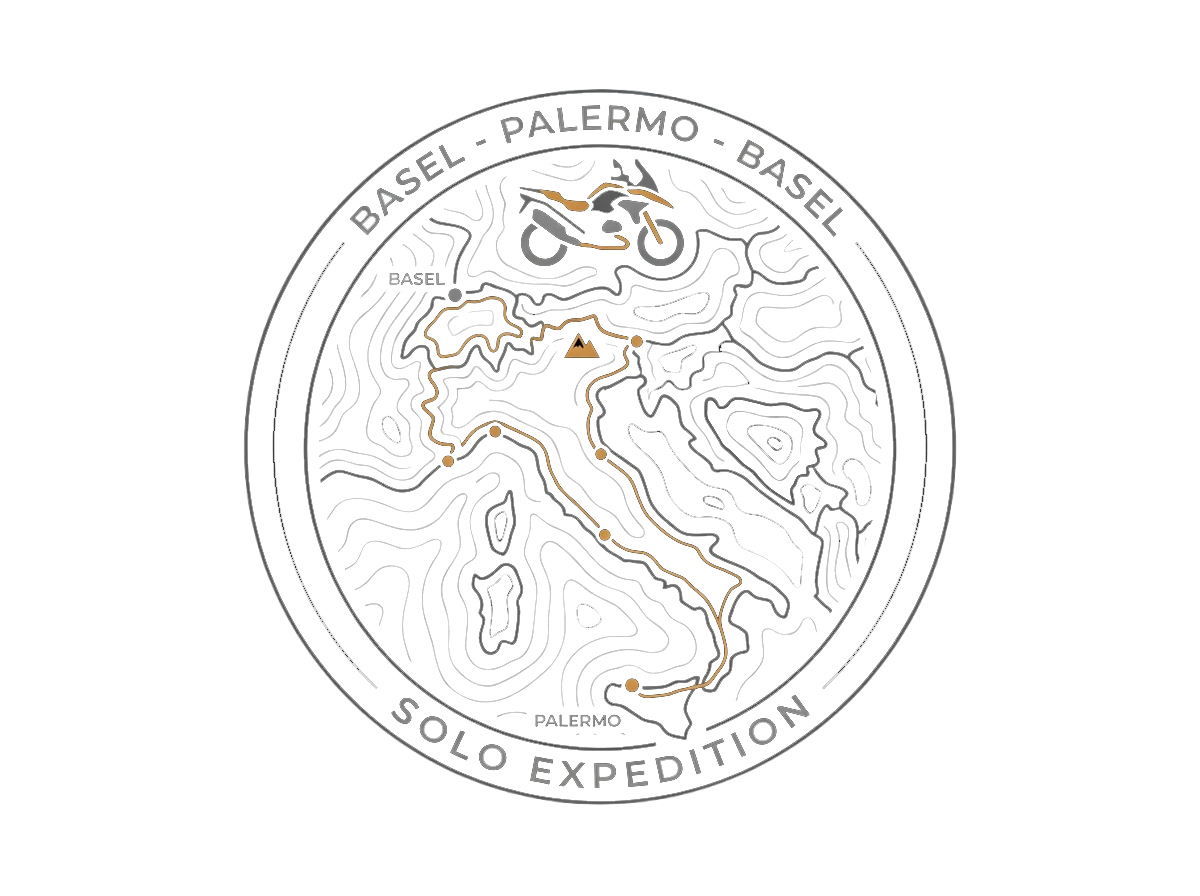
The Long Circle South
RMG Riding Adventures / Solo Motorcycle Expedition / 2026
Route Overview
Depart Basel and penetrate the Alps, descending into Italy through mountain passes, inland ridgelines, and coastal corridors. Continue south through Tuscany, Lazio, and Campania, cross to Sicily, and reach Palermo. Prioritize secondary roads, geographic transitions, and terrain diversity over direct transit.
Day-by-Day Itinerary
| Day | Date | Segment | Route | Region | Distance | Duration |
|---|---|---|---|---|---|---|
| -5 | 16/11/2025 | Preparing the Ride - Off Road Training - Lets Get DirtyRest | Hechlingen am See | Germany | — | — |
| -4 | 16/02/2026 | Preparing for a Long-Distance Motorcycle Expedition – Switzerland Setup DayPrep | Schonenbuch | Switzerland | — | — |
| -3 | 17/02/2026 | Route Finalized – Basel to Palermo and Back Motorcycle Expedition ReadyPrep | schonenbuch, switzerland | — | — | — |
| -2 | 08/03/2026 | Training / TestingRest | Schonenbuch — Schonenbuch | Switzerland | — | — |
| -1 | 13/03/2026 | Friday Drone and 360 TestPrep | Basel — Basel | France | — | — |
| 1 | 01/05/2026 | Basel to Lugano Motorcycle Route — Swiss Plateau to Alpine Foothills | Schönenbuch — Lugano | Switzerland | 322 km | 7h 29m |
| 2 | 02/05/2026 | Lugano to Genua — Alps to Ligurian Coast Transition | Lugano — La Spezia | Italy | 327 km | 8h 50m |
| 3 | 03/05/2026 | Genua — Lunigiana & Northern Apennines Mountain Traverse | La Spezia — Florence | Italy | 585 km | 10h 23m |
| 4 | 04/05/2026 | Sienna to Corte Fiore — Chianti, Val d’Orcia & Lake Bolsena Scenic Inland Ride | Sienna — Corte Fiore | Italy | 345 km | 6h 26m |
| 5 | 05/05/2026 | Corte in Fiore - Rain Day 1Rest | Ardea 00040 | Italy | — | — |
| 6 | 06/05/2026 | Corte Fiore - Rain Day 2Rest | Ardea 00040 | Italy | — | — |
| 7 | 07/05/2026 | Corte Fiori – Positano | Into the Vertical South | Core in Fiori — Positano | Italy | 272 km | 8h 48m |
| 8 | 08/05/2026 | Positano – Lauria | Out of the Cliffs, Back to Distance | Positano, Italy — Cirela, Italy | Italy | 298 km | 8h 10m |
| 9 | 09/05/2026 | Lauria – Tropea | Into the Calabrian Spine | Lauria, Italy — Tropea | Italy | 294 km | 7h 54m |
| 10 | 10/05/2026 | Taurionova – Forza D'Agro | Taurionova, Italy — Forza D'Agro, Sicily | Italy | 202 km | 6h 29m |
| 11 | 11/05/2026 | Forze D'Agro – Noto | Castelmola — Syracuse | Italy / Sicily | 254 km | 7h |
| 12 | 12/05/2026 | Noto – Agrigento | Across the Quiet Interior | Noto, Italy — Agrigento | Italy / Sicily | 192 km | 4h 39m |
| 13 | 13/05/2026 | Agrigento – Palermo | Through Corleone’s Shadow | Agrigento — Palermo | Italy / Sicily | 256 km | 8h 28m |
| 14 | 14/05/2026 | Palermo Rest Day — Family Reunion & First Full Stop at the Southern Turning PointRest | Palermo, Italy | — | — | — |
| 15 | 15/05/2026 | Palermo | Expanding the FrameRest | Palermo, Italy | — | — | — |
| 16 | 16/05/2026 | Palermo Rest Day — Cefalù Coastline & Quiet Closure Before the ReturnRest | palermo, Italy | Italy / Sicily | — | — |
| 17 | 17/05/2026 | Palermo – Messina | Northern Corridor | Palermo — Messina | Italy / Sicily | 250 km | 6h 51m |
| 18 | 18/05/2026 | Messina – Catanzaro | Re-entering the Spine | Messina — Catanzaro | Italy | 214 km | 5h 3m |
| 19 | 19/05/2026 | Soverato – Matera | From Coastal Plain to Stone Memory | Soverato — Matera | Italy | 375 km | 7h 10m |
| 20 | 20/05/2026 | Matera Rest Day | Suspension in StoneRest | Matera | Italy | — | — |
| 21 | 21/05/2026 | Matera – Carovigno | From Cave Cities to Coastal Wind | Matera — Gallipoli | Italy | 167 km | 4h 45m |
| 22 | 22/05/2026 | Carovigno - Lecce- Leuca - Otranto | Carivagno — Lecce | Italy | 322 km | 9h 20m |
| 23 | 23/05/2026 | Carovigno - Rest Day, Wind DayRest | Carovigno, Italy | — | — | — |
| 24 | 24/05/2026 | Carovigno - Termoli | Carovigno — Lesina | Italy | 308 km | 6h 31m |
| 25 | 25/05/2026 | Lesina - San Bendetto del Tronto - Leaving the South | Lesina — San Benedetto del Tronto | Italy | 375 km | 8h 39m |
| 26 | 26/05/2026 | San Benedetto del Tronto - Rimini | San Benedetto del Tronto — Rimini | Italy | 337 km | 9h 17m |
| 27 | 27/05/2026 | Rimini to Bassano del Grappa | Rimini — Bassano del Grappa | Italy | 267 km | 6h 4m |
| 28 | 28/05/2026 | Bassano del Grappa - Vipiteno | Bassano del Grappa — Sterzing | Italy | 313 km | 8h 3m |
| 29 | 29/05/2026 | The Circle Closes — from alpine silence back into the familiar lowlands | Vipiteno — Schönenbuch | Switzerland | 461 km | 9h 32m |
| Total | 6,292 km | |||||
Segment Notes
Day -5 — Preparing the Ride - Off Road Training - Lets Get Dirty
s preparation for the Basel → Palermo → Basel solo expedition, I completed an official BMW Motorrad Offroad Training in Germany.
Before riding thousands of kilometers across Italy — including mountain passes, remote coastal roads, gravel sections, and potential unplanned terrain — I wanted structured training beyond road touring.
This session focused on:
• Body positioning in standing posture • Throttle and clutch control on loose surfaces • Controlled braking on gravel • Slow-speed balance and obstacle work • Hill starts and descents off asphalt • Recovering an adventure bike
The goal was not speed. It was control.
On a fully equipped adventure motorcycle, mistakes off-road are amplified by weight and momentum. Training removes hesitation and builds muscle memory before real terrain forces the issue.
This video documents key exercises, corrections, and takeaways as I prepare for the long circle south.
Bike platform: BMW adventure class Training provider: BMW Motorrad Offroad Training Location: Germany
This expedition is built on preparation, not improvisation.
Day -4 — Preparing for a Long-Distance Motorcycle Expedition – Switzerland Setup Day
Before a multi-week motorcycle expedition, small oversights become major problems. Today is about eliminating those risks.
The motorcycle has been serviced, but practical setup matters more:
• Gear test packed and repacked for accessibility • Tool kit confirmed • Electronics charged and tested • Navigation routes double-checked • Weight distribution reviewed
Everything must have a fixed place. Every item must justify its weight.
The expedition officially begins May 1st 2026
Day -3 — Route Finalized – Basel to Palermo and Back Motorcycle Expedition Ready
The route is finalized.
Every segment defined, every Alpine pass considered, every coastal deviation intentional. What was abstract is now concrete: a continuous line from Basel to Sicily and back.
The planning phase is over.
Palermo stands as the midpoint — not just geographically, but psychologically. A deliberate pause in the center of the expedition. A reset before turning north.
There is nothing left to adjust.
Only to ride.
A soundtrack was created for this expedition — part of the preparation ritual. https://lnk.to/3lxwwIWb
Day -1 — Friday Drone and 360 Test
Today was a systems test rather than a ride for distance. The goal was simple: confirm that the filming setup actually works in real conditions before the expedition begins.
The route left Basel and climbed quickly into the quieter countryside and forest roads toward the Jura. A mix of asphalt and gravel provided the right testing ground. The drone was the main focus. The NEO2 followed from the front while riding, capturing the bike moving through bends and narrow roads. Tracking held stable even on curving sections, which was exactly the scenario that worried me most.
The second layer of testing involved the DJI 360 camera. Mounted on the bike, it recorded continuously to evaluate field of view, vibration behavior, and framing possibilities for later editing. On-road footage worked smoothly, while the off-road sections revealed where stabilization matters most.
The combination of drone tracking and 360 capture opens a lot of creative possibilities for documenting the journey. The key challenge is always the balance between riding and filming. Today confirmed that the setup can operate without constantly stopping or breaking the rhythm of the ride.
By the time the loop returned to Basel, the technical side felt solid. Cameras, drone tracking, and mounting positions all behaved as expected. The system now feels ready for the real expedition.
Day 1 — Basel to Lugano Motorcycle Route — Swiss Plateau to Alpine Foothills
The first leg is behind me: Basel to Lugano.
It was one of those days that reminds you quickly what this kind of journey actually demands. Long hours in the saddle, heat building steadily, and a route that, on paper, looked cleaner than it turned out to be in reality.
Navigation was the weak point today. Strevo.io, which I set up to guide me along more adventurous tracks, struggled in Switzerland. Several routes led onto paths that were simply not legal to ride, others ended abruptly in dead ends. What’s designed to feel like exploration can quickly turn into friction when you’re forced to constantly reassess, backtrack, and improvise.
Lesson one: “adventure mode” needs calibration. Tomorrow, I dial it back.
The Gotthard Pass forced the next compromise. Still closed. The alternative would have meant a multi-hour detour, so for the first time, I broke the rule: no highways. I took the tunnel. Not scenic, not part of the original idea, but pragmatic. Crossing the Alps sometimes isn’t about purity, it’s about progression.
Arrival in Lugano came with that familiar mix: fatigue, relief, and a quiet sense of forward motion. The lake, the warmer air, the shift in atmosphere—it already feels like a different chapter.
Now: first night at the campsite. Gear unpacked, bike cooling down, body catching up.
Tomorrow, adjustments begin.
Day 2 — Lugano to Genua — Alps to Ligurian Coast Transition
Alps to Sea — Completed, Reframed
The plan was exact: Lugano to La Spezia. A clean, uninterrupted descent from alpine terrain into the Ligurian coast. Distance defined. Endpoint fixed.
Execution diverged, but the core objective held.
The ride reached the sea—Genova. The vertical transition is complete. Mountains to Mediterranean, fully realized. The only element that shifted was the finish line along the coast. La Spezia remains on the map, but Genova became the correct endpoint under real conditions.
Stegra.io behaved differently today. After yesterday’s friction, it delivered what it promises: tight, paved curves, flowing secondary roads, proper riding lines. The quality improved. The trade-off became obvious—time inflation. Curves extend distance in practice. What looks efficient on a map compounds into hours on the saddle.
The route improved. The duration expanded.
At the same time, the body introduced a hard constraint. Sustained riding translated into increasing back strain. Not marginal—decisive. The decision was not about preference but about preserving the journey beyond today.
Genova closed the segment.
There was also a missed layer in the execution. Alongside the paved curves, multiple gravel options appeared—clean, structured, clearly rideable. They would have reduced pace, redistributed load, and likely improved overall control of the day. The selection stayed on asphalt. The consequence was higher cumulative strain and longer exposure.
Delta between plan and ride:
- Objective: achieved — full Alps-to-sea transition
- Endpoint: adjusted — Genova instead of La Spezia
- Routing: high-quality paved curves, but time-expensive
- Missed optimization: gravel segments that would have improved pacing and load distribution
- Constraint: physical limit overriding route completion
The route is no longer about distance optimization. It becomes a selection problem: terrain, load, and sustainability.
Next segment is defined: Genova to Siena.
Day 3 — Genua — Lunigiana & Northern Apennines Mountain Traverse
Today’s stretch ran from Genova into the Tuscan interior, ending in Siena.
The opening section inland set the tone. Tight, irregular roads cutting through the hills behind the coast — not the kind you glide through, but the kind you work through. Constant transitions, uneven surfaces, quick changes in elevation. At times beautiful, at times frustrating. A few of those segments felt like they existed more on a map than in reality — narrow, partially broken, occasionally leading nowhere useful. It demanded attention early on, both mentally and physically.
But that phase passed.
As the route pushed further south and east, the roads began to open, and with them, the ride itself. Tuscany unfolded in long, flowing stretches — wide views, soft curves, and a rhythm that finally allowed for consistency. This is where the day shifted from effort to enjoyment.
The body followed that same trajectory. Yesterday there was resistance. Today, adaptation. The back settled, posture improved, and the hours became manageable. Not effortless, but controlled. Practice is starting to translate into performance.
Florence was originally a planned stop. That changed mid-ride. With unstable weather ahead, stopping became secondary to positioning. So the decision was made to push through and use Siena as a tactical waypoint rather than a destination.
The plan now is defined by movement, not location. Stay ahead of the weather. If executed cleanly: a stop somewhere south of Rome, then a faster transition toward Positano.
This is no longer about following a predefined route. It’s about making the route work.
Day 4 — Sienna to Corte Fiore — Chianti, Val d’Orcia & Lake Bolsena Scenic Inland Ride
From Siena to the Edge of Rome: Riding the Spine of Italy — and Knowing When to Stop
The line on the map looks simple. It isn’t.
South of Siena, the character of the ride shifts immediately. The soft, postcard curves of Tuscany tighten into something more deliberate. The road begins to carve through hills rather than flow over them. Fewer tourists, fewer perfect viewpoints, more raw terrain. This is where the ride becomes quieter—and more honest.
The early stretch carries you through fragmented farmland and rolling ridgelines, where the asphalt is good but no longer forgiving. Corners demand attention. Elevation changes come sharper than expected. The landscape feels less curated, more lived-in. It’s a transition zone—geographically and mentally.
Approaching the Umbrian edge, the roads narrow further. Villages appear suddenly, perched above valleys, then disappear just as quickly. There’s a rhythm: climb, descend, tighten, release. No long straights. No autopilot. The bike works. You work.
The route bends, threads between lakes and ridges, then commits south again. Traffic stays light. The surface varies—mostly solid, occasionally broken, just enough to keep focus high. It’s the kind of riding that rewards patience over speed. No hero lines. Just precision.
As Rome begins to pull closer, the tension builds. Not visually at first, but structurally. Roads widen. Intersections multiply. The sense of isolation fades. You feel the system again, movement, density, friction. After hours of controlled solitude, it’s abrupt.
Then Rome.
Not entered cleanly. Not welcomed gradually. It hits. Traffic compresses, navigation becomes tactical, and the final kilometers demand more awareness than the previous hundred. It’s chaotic, but not random. There’s a logic underneath—fast, aggressive, but readable if you commit to it.
And then, just as quickly, you’re through it.
South of the city, the air shifts again. Less pressure. Fewer vehicles. The road opens slightly, carrying you toward the coast. The final stretch feels like release, not because it’s easy, but because it’s earned.
And this is where the plan changes.
Not because of failure. Because of conditions.
Rain moves in. Not a passing inconvenience, but a multi-day system. Riding through it would turn precision into risk, flow into fatigue. So the ride pauses—not on the roadside, but deliberately—at Corte in Fiore.
This is not just accommodation. It’s a reset point.
Positioned just south of Rome, it sits outside the pressure zone. Close enough to have crossed the system, far enough to disconnect from it. The terrain flattens. The noise drops. After the intensity of inland riding, everything here slows down.
The logic shifts: Movement → stillness Execution → recovery Route → reflection
The body catches up. The mind recalibrates. The bike rests.
In a trip defined by motion, this becomes part of the structure. Not an interruption—an integration.
The road forces movement. The rain enforces stillness. Both belong to the same journey.
This segment isn’t just about what was ridden. It’s about recognizing when not to ride—and turning that into advantage.
The south will wait.
Day 5 — Corte in Fiore - Rain Day 1
Today was not about distance. It was about control.
After arriving yesterday in Siena, the plan for the next leg collapsed under a simple constraint: three days of rain, steady and unavoidable. No tactical departure window, no detour that would meaningfully improve the situation. Continuing would have meant hours of riding without gain.
So the decision was made early—hold position at Corte in Fiori.
The bike stayed parked. Gear stayed dry. The day shifted from execution to optimization.
Morning started with maps and routing tools. The upcoming segments were reworked from first principles: fewer compromises, cleaner lines, better sequencing between coast and inland sections. Yesterday’s routes were adjusted, not extended. The objective changed from “progress” to “quality of movement.”
Weather checks confirmed the call. Rain across the region for the next 48–72 hours. No ambiguity. Waiting was not a fallback—it was the correct move.
With the route stabilized, focus moved to content. Footage from the previous days—Basel through the Alps, the long push south, the navigation friction—was reviewed and structured into short clips. The narrative started to form.
Publishing failed.
Weak WiFi, no 5G. Upload attempts stalled repeatedly. Progress bars froze. Retries didn’t change the outcome. The constraint shifted from road conditions to bandwidth. The result was the same: pause.
By afternoon, the system was reset.
Route ahead optimized Shelter secured Equipment dry Body recovered Content prepared, but queued
No kilometers were added today. That was deliberate.
The value came from removing friction ahead of time instead of carrying it forward.
Dinner closes the day without urgency. The plan is set. The weather will continue. Movement resumes when conditions justify it.
48 hours on hold. No loss.
Day 6 — Corte Fiore - Rain Day 2
The American cemetery near Anzio does not overwhelm through size. It overwhelms through silence.
Row after row of white crosses and Stars of David stand in absolute geometric order, facing the sea they once crossed as young men. Most of them were barely older than boys. They arrived here in 1944 not for conquest, not for territory, but because Europe had descended into something corrosive and authoritarian that had already consumed millions of lives.
Walking through the Sicily–Rome American Cemetery today forces a confrontation with a dangerous modern illusion: the belief that freedom is permanent.
It is not.
Freedom is maintained only when people are willing to defend institutions, pluralism, democratic norms, and human dignity against movements built on fear, nationalism, scapegoating, and the concentration of power. The men buried at Anzio understood that more clearly than most people alive today ever will.
The Anzio landings were brutal. The campaign became a deadlock of artillery, mud, attrition, and relentless casualties. Thousands died in conditions that shattered any romanticism about war. Yet those sacrifices formed part of a broader effort that pushed back fascism in Europe at a moment when authoritarian regimes appeared unstoppable.
That history matters again.
Because across parts of the world—including countries many once believed institutionally immune—we are witnessing the re-emergence of political movements that increasingly normalize authoritarian language, contempt for democratic processes, hostility toward minorities, attacks on independent media, and personality-driven nationalism.
Even the United States, once viewed as a stable anchor of liberal democracy, now shows fractures that would have seemed unthinkable decades ago. Political polarization has deepened into something more structural: distrust of institutions, aggressive populism, ideological tribalism, and the rehabilitation of rhetoric that echoes darker periods of history.
History rarely returns wearing the exact same uniform.
It adapts. It modernizes. It speaks the language of grievance instead of doctrine. But the underlying mechanisms remain recognizable.
That is why places like Anzio matter.
Not as tourist landmarks. Not as military nostalgia. But as physical reminders of the cost humanity once paid when authoritarianism was allowed to metastasize unchecked.
The cemetery is immaculately maintained. The grass is perfect. The marble is clean. But beneath that order lies an uncomfortable truth: every grave represents a future that was erased so that others could continue theirs.
A father never met. A business never built. A family line ended permanently. A life interrupted on foreign soil.
The obligation of later generations is not merely remembrance. It is vigilance.
To cherish freedom means more than celebrating it when convenient. It means defending democratic principles precisely when fear, anger, economic instability, or tribal politics make authoritarian shortcuts appear attractive.
Anzio is a reminder that fascism was not defeated by speeches alone. It was defeated by sacrifice.
And cemeteries like this exist because previous generations understood that some lines, once crossed, become catastrophically difficult to reverse.
Day 7 — Corte Fiori – Positano | Into the Vertical South
The rain never arrived the way the forecasts promised.
After two days paused at Corte in Fiori, the expedition finally moved south again. The morning opened with blue skies, dry roads, and unexpected heat climbing toward 27°C. Layers came off quickly as Tuscany slowly transitioned into the landscapes of Campania.
For a while, everything flowed exactly as planned.
Then #Stegra.io failed again.
Several off-road connector tracks that looked perfectly fine on the map simply did not exist in reality. Gravel roads ended at locked gates. Trails dissolved into dead ends. More than once, the fully loaded 400kg motorcycle had to be unpacked and physically turned around on narrow uphill sections under the afternoon sun.
That was the decision point.
No more tracks. Back to actual roads.
And honestly, the moment the route returned to the Amalfi coastline, everything changed again. The frustration disappeared beneath cliffside curves, sea air, stacked villages, tunnels cut through rock, and long panoramic stretches above the Mediterranean.
This was the road the expedition had been chasing since Basel.
By evening, arrival came at B&B La Perla Dei Gemelli in Campania. The bike finally stopped. The heat remained in the stone walls long after sunset. And the landlord served a surprisingly good homemade wine that tasted even better after a day like this.
The navigation failed. The road did not.
And somewhere between the blocked trails, the uphill turnarounds, and the first full Amalfi panorama, the expedition found its rhythm again.
Day 8 — Positano – Lauria | Out of the Cliffs, Back to Distance
The push south continued today.
Departure from Amalfi began under a careful and almost deceptive sun. After days of rain forecasts and delayed movement, the morning felt unexpectedly calm—warm light over the coast, dry roads, and the sense that perhaps the weather had finally lost interest in the expedition.
It had not.
As the route moved inland, the landscape changed rapidly. The coastline disappeared behind mountain ridges and the roads became narrower, emptier, and more remote. Stegra.io once again delivered exactly what it promised: roads far away from efficiency and very close to experience.
The route crossed through beautiful national park territory where civilization slowly faded into silence. Traffic disappeared almost entirely. Instead, the roads belonged to animals and the people still working among them.
Cows stood directly on the asphalt without urgency. Wild horses appeared around blind curves as if they had emerged from another century. And somewhere deeper into the mountains, the ride slowed completely for a shepherd guiding his flock of sheep across the road, accompanied only by two dogs and patience.
It felt less like crossing Italy and more like crossing time.
Rain eventually returned later in the afternoon, slowly at first and then steadily enough to end any realistic campsite ambitions for the night. The expedition adapted once again—not through retreat, but through pragmatism.
Tonight’s stop became Villa Malibu in Lauria, where tremendous hosts replaced wet tents and uncertainty with warmth, food, and shelter.
Tomorrow, the route returns toward the coast.
And for the first time in several days, the forecast finally seems willing to cooperate with one of the original ideas behind Long Circle South: a campsite, the sea, and a night outside again.
Day 9 — Lauria – Tropea | Into the Calabrian Spine
Today was supposed to end with a tent near Tropea.
That was the plan when departure began this morning from Lauria under clear skies and surprisingly warm temperatures. After days of rain, delays, rerouting, and shelter stops, the south finally opened itself properly: dry asphalt, sunlight across Calabria, and long flowing roads cutting between mountains and coastlines.
The route itself delivered exactly what the expedition had hoped for.
Remote interior sections slowly transitioned into faster southern connectors, while the Tyrrhenian returned repeatedly into view. The roads felt lighter today. Less defensive riding, less weather management. Momentum returned.
But the real story of the day became something else entirely: the disappearing campsite.
The objective had been simple — reach the coast near Tropea and finally return to one of the core ideas behind Long Circle South: camping.
Reality disagreed.
The first campsite: closed. The second: abandoned after reviews suggested it should stay that way. The third option required another thirty minutes southbound, only to reveal that the “campsite” had effectively become a bungalow resort with almost no real camping atmosphere left.
So once again, the expedition adapted.
The coastline was left behind for the evening and the route turned inland toward Taurianova instead, where tonight’s stop became Ciclari B&B — another unexpected landing point that traded tent poles for hospitality.
No frustration, strangely enough.
That has become part of the rhythm now: plans remain important, but reality keeps editing them.
And Calabria continues to reward the flexibility.
Warm air. Empty roads. Long sunlight. Southern Italy slowly becoming less European and more Mediterranean with every kilometer further south.
Tomorrow, the expedition moves again. And eventually, the campsite will happen.
Day 10 — Taurionova – Forza D'Agro
Today did not begin with departure. It began with waiting.
Thunderstorms rolled across Calabria early in the morning, heavy enough to delay the route south and force a slower start than planned. Rain hammered outside Ciclari B&B while the expedition paused once again between patience and movement, watching weather radar instead of asphalt.
Eventually the system opened.
The rain weakened, the roads dried just enough, and the push toward Sicily resumed under unstable skies and humid southern heat. Calabria slowly dissolved into transition territory — long coastal connectors, warmer air, and the growing realization that the mainland was ending.
Then came the Strait.
Crossing into Sicily feels operational rather than ceremonial. Ferries move constantly, vehicles compress together without urgency, and within minutes the continent simply disappears behind you. Yet something changes immediately after arrival.
Sicily feels older.
The route refused the obvious coastal line southward and instead climbed into the hills above the Ionian coast. Villages appeared attached directly to cliffs and ridgelines. Roads stopped behaving logically and started behaving historically.
And eventually: Forza d’Agrò.
The village carries a strange familiarity even before arrival because parts of The Godfather were filmed here. Francis Ford Coppola originally wanted to use the real town of Corleone, but by the 1970s it had modernized too much for the timeless Sicily he imagined. Instead, production moved to villages like Forza d’Agrò and nearby Savoca, whose stone alleys, old churches, and untouched atmosphere became the cinematic Sicily seen in the trilogy.
And standing below the village tonight, it makes complete sense.
The place does not feel curated for tourism. It feels suspended somewhere between history and cinema, unchanged enough that the fictional memory of Sicily still overlaps with the real one.
Tomorrow, the expedition climbs into the village itself.
Tonight’s Air B&B sits just below the hill overlooking the coast, with Sicily now fully replacing the mainland rhythm of the ride. The roads are narrower, the villages older, and the expedition itself beginning to slow into something less about movement and more about immersion.
Day 11 — Forze D'Agro – Noto
The day started above the Ionian coast, beneath the cliffs of Forza d’Agrò — the same stone village where The Godfather found its version of Sicily. By mid-morning, the route turned south around Etna, and the island changed character completely.
Mount Etna dominates everything around it. The scale is difficult to describe until you ride it yourself: black volcanic fields, hardened lava flows, smoke above the summit, and roads cutting through terrain that feels unfinished by nature. It is less a mountain than a living system.
One unpleasant moment cut through the day. While stopping near Etna to take photographs, my reading and sunglasses disappeared. A reminder that even in extraordinary places, not every encounter leaves a good impression.
The rest of the ride corrected the balance.
The inland Sicilian roads were exceptional — narrow connectors, volcanic curves, empty stretches through forgotten villages and dry hillsides. Less traffic, less structure, more rhythm. The kind of riding that makes you stop checking distance and simply follow the road.
By evening, the route descended toward the south-east interior and the B&B. Warm air, dust on the bike, volcanic stone still everywhere in the landscape.
Sicily feels different from mainland Italy.
Rougher. More isolated. More alive.
And today, that was exactly the point.
Day 12 — Noto – Agrigento | Across the Quiet Interior
Today was the opposite of Etna.
No volcanic dust, no dead-end tracks, no missing roads hidden behind gates. Just a long southern coastline, warm air coming off the Mediterranean, and the first real exhale in days.
The route from Ragusa to Agrigento was intentionally simple. Fewer technical sections, fewer surprises, fewer decisions. After the intensity of inland Sicily, the expedition shifted back toward flow instead of focus. The sea stayed close for most of the day, sometimes only meters away, sometimes opening wide beyond empty beaches and dry fields.
The campsite finally happened.
After rain delays, closed campgrounds in Calabria, improvised B&Bs, and tactical reroutes, the tent went up under trees near the coast exactly as this expedition was originally imagined. No lobby. No reception desk. No waiting for keys. Just shade, dust, sea wind, and the sound of fabric tightening under tension.
By 14:00 the camp was set.
At one point, the boots came off and my feet went into the sea.
A small moment, but an important one. The expedition stopped feeling like a sequence of transfers and started feeling anchored in the south itself.
Along the way, Sicily kept reminding me that beneath the postcard imagery sits another layer entirely. One roadside sign marked land confiscated from the mafia — a quiet but powerful statement that the island continues to reclaim itself, piece by piece. Sicily carries beauty and tension in the same landscape.
By late afternoon the bike was parked, gear unpacked, and the camp settled into stillness under the trees.
No hotels tonight. No strategy adjustments. No weather escape plans.
Just the tent, the sea, and the sound of the island slowing down.
Day 13 — Agrigento – Palermo | Through Corleone’s Shadow
Sicily kept changing character today.
The morning began in Agrigento at the Valley of the Temples — one of those places that completely resets perspective. Massive Greek temples standing above the Mediterranean, older than most people instinctively realize. Long before Rome dominated the island, Sicily was deeply tied to Magna Graecia, the network of Greek colonies spread across southern Italy. What remains in Agrigento is not ruin in the usual sense; it is scale, geometry, and continuity. Columns still standing after more than two thousand years under the Sicilian sun.
Then the road changed completely.
The coast disappeared and the expedition moved inland toward Corleone. The further away from the sea, the rougher and more uncertain the roads became. “Road” occasionally became an optimistic term. Broken surfaces, gravel sections, disappearing connectors, and stretches where the route felt closer to a suggestion than infrastructure. More than once I wondered whether turning around would have been the smarter option.
But Corleone had to be visited.
Not because of tourism clichés, but because Sicily carries its stories directly in the landscape. The name exists far beyond the island because of fiction, but the terrain itself explains why power once concentrated in places like this: isolated hills, difficult access, strong local identity, and a geography built around control of movement.
From there the route pushed further toward Camporeale — the roots of Don Carlo Rizzuto’s family. At that point the day had already become physically and mentally demanding. Heat, rough roads, navigation uncertainty, and long hours inland started stacking together. Still, the bike kept moving. Sometimes slowly, sometimes questioning the route entirely, but always forward.
By evening, Palermo finally appeared.
The contrast was immediate. After remote inland Sicily came density, noise, movement, architecture, and history layered on top of itself. The family-style B&B sits only fifty meters from Palermo Cathedral and the UNESCO-listed Arab-Norman heritage zone — one of the clearest reminders that Sicily was never culturally singular. Greek, Arab, Norman, Spanish, Italian — the island absorbed everything and turned it into its own identity.
Tonight the expedition pauses in the middle of that history.
Dusty roads behind. Palermo alive outside the window. And somehow, despite the terrain, the wrong turns, and the disappearing roads, the machine made it all the way through.
Day 14 — Palermo Rest Day — Family Reunion & First Full Stop at the Southern Turning Point
Arrival in Palermo defines the endpoint of the southbound line. The Basel-to-Sicily trajectory resolves here, not as a finish, but as a structural pivot. Movement stops. The system consolidates.
The city does not present itself cleanly. Layers overlap—Arab-Norman mass beside baroque excess, markets pushing into narrow streets, noise and density without orchestration. Palermo is not composed for viewing. It operates on its own terms.
The family converges. The objective shifts from distance to proximity. The motorcycle remains parked while the focus moves inward—Palermo Cathedral, Palazzo dei Normanni, Ballarò, Vucciria. Walking replaces riding. Time replaces speed.
This day closes the outbound arc and resets the frame. From progression to presence.
Day 15 — Palermo | Expanding the Frame
The second full day in Palermo extends beyond the historic core into a wider geographic and cultural field. With no compression pressure, the day unfolds in layers rather than sequence.
The morning remains anchored in the city. The Palazzo dei Normanni and Cappella Palatina expose the Arab-Norman synthesis at structural level—ornament, geometry, and political history fused into a single system. Movement through Quattro Canti, Piazza Pretoria, and the Cathedral completes the internal axis. The city is not explored—it is read.
Midday introduces elevation. Monreale shifts the perspective from immersion to overview. The cathedral’s mosaics operate at a different scale—total, continuous, uncompromising. From the terrace, Palermo resolves below: dense, unfiltered, contained by mountains. The relationship between city and terrain becomes explicit.
Late afternoon releases toward the coast. Mondello provides contrast—open water, light, and spatial clarity after hours of compression. The objective is not activity but recalibration.
There is no need for acceleration. The system expands. Depth replaces coverage.
Day 16 — Palermo Rest Day — Cefalù Coastline & Quiet Closure Before the Return
The third and final rest day in Palermo is a controlled widening before contraction. The motorcycle remains parked. Movement is optional, outward, and deliberately light.
The morning extends east along the Tyrrhenian coast toward Cefalù. The town resolves quickly—Norman cathedral at center, the Rocca rising behind, sea fixed ahead. It is a balanced composition of stone, elevation, and water. From the summit, the coastline stretches in long arcs—the same Tyrrhenian line that will guide the return north.
Cefalù operates as contrast. Lower density, contained scale, reduced noise. After Palermo’s compression, it simplifies the system without diluting it.
The return to Palermo restores base position. The evening is functional: review the southbound phase, prepare the motorcycle, reset the frame. The pivot is explicit—arrival transitions into departure.
This day closes the Sicilian interlude. The line turns north.
Day 17 — Palermo – Messina | Northern Corridor
After four nights in Palermo, the expedition moved again — but differently.
The departure eastward was intentionally lighter. No inland gravel labyrinths, no collapsing tracks, no mountain dead ends demanding another 400-kilogram turnaround. Today followed the northern coastline of Sicily toward Messina with a simpler objective: regain rhythm.
The Tyrrhenian stayed close for most of the ride. Fishing towns appeared and disappeared without announcement. The road rolled between sea, rock, rail lines and faded coastal buildings that seemed untouched for decades. Sicily here feels stretched horizontally — less dramatic than the interior, but deeply atmospheric.
The pause in Palermo changed the pace of the expedition. The body recovered. The mind slowed down. The constant tactical thinking of the previous days gave way to flow again.
This stage was not about proving anything. It was about continuity.
Messina now waits ahead — the final Sicilian threshold before the mainland returns. One more night on the island. One more line along the coast before the expedition turns north again.
The roads were easier today. The island was not smaller because of it.
Day 18 — Messina – Catanzaro | Re-entering the Spine
Blog
Today was intentionally uncomplicated.
After Sicily, mountain crossings, inland gravel detours and constant route adaptation, the expedition shifted into a slower cadence. The original plan was abandoned early in favor of a simpler coastal line north through Calabria.
But before the road continued, the BMW R1300 GSA stopped for something equally important: its 10,000 km service.
At Barletto Moto Service, the machine received attention before the next stages north. Oil, inspections, preparation — and a rear brake replacement after the punishment of gravel tracks, mountain descents and overloaded expedition riding across southern Italy and Sicily.
Expeditions are not only built on landscapes and decisions, but on maintenance and trust in the equipment carrying the journey forward.
Only then did the route continue.
No tactical riding. No endless rerouting. No fighting the road.
The Mediterranean stayed close almost the entire day. Villages passed quietly, traffic remained light, and for the first time in a while the ride felt less like an expedition phase and more like sustained movement.
By midday, the campsite was already established.
Tent up. Gear drying. Helmet off before afternoon.
The remainder of the day moved from riding into planning. Maps reopened. Next stages reviewed. Distances reconsidered. The expedition is gradually turning north again, and the rhythm changes with it.
Not every stage needs to be difficult to matter.
Some days exist to create margin before the next unknown section begins.
Day 19 — Soverato – Matera | From Coastal Plain to Stone Memory
Today began early.
After a night of almost no sleep at Camping Lungomare — strong coastal winds shaking the tent until nearly 03:00 — the expedition restarted at 07:30. Coffee, pack-up, engine on.
The original route north was temporarily abandoned for two places that did not fit the official expedition logic, but absolutely deserved a detour.
First: Craco.
A ghost town rising from the hills of Basilicata like a collapsed fortress. Abandoned after landslides and instability forced residents away decades ago, the village now stands frozen above the valley — empty streets, broken stone houses, silence and wind. One of those rare places where decay itself becomes architecture.
Then onward to Matera.
And suddenly the landscape changed completely.
Matera does not feel like a normal city. It feels excavated from another age. The ancient “Sassi” districts — cave dwellings carved directly into the rock — are among the oldest continuously inhabited settlements in the world. Greeks, Romans, Byzantines, monks, farmers, entire generations lived inside the stone itself.
No modern planning. No symmetry. Just layers of survival becoming beauty.
The ride there was equally memorable. Long open roads, dry heat, powerful winds crossing the plains, and surprisingly empty stretches through southern Italy’s interior. Not technical riding, but atmospheric riding.
Today was cheating.
But some places are worth breaking the structure for.
And unlike the usual transit mentality of the expedition, Matera earns time. So for once, the motorcycle stays parked tomorrow.
One full day off the bike. One full day inside history.
Day 20 — Matera Rest Day | Suspension in Stone
A Day Inside Matera
After days of movement, engines, ferries, campsites, mountain roads, gravel tracks, and endless navigation decisions, Matera forced the expedition to stop moving.
Not pause. Stop.
No luggage loading in the morning. No route calculations. No weather radar. No pressure to reach the next point before sunset.
Just a full day inside one of the oldest continuously inhabited cities on Earth.
Matera is difficult to explain properly because it does not behave like a normal city. It feels layered vertically through time. Streets become rooftops. Houses disappear into caves. Staircases lead nowhere visible until another hidden square suddenly opens beneath you.
The Sassi districts are carved directly into limestone and were inhabited for thousands of years. Entire families once lived inside these caves together with animals, water reservoirs, and storage rooms. Looking at it today, under southern sunlight and filled with cafés and visitors, it is hard to imagine that Matera was once considered one of Italy’s poorest places.
Now it feels more like an archaeological memory still functioning as a living city.
The entire day became exploration on foot: stone alleys, hidden arches, churches carved into rock, viewpoints over the canyon, small streets where silence suddenly replaces tourism again.
There is something strangely cinematic about Matera. Not in the artificial sense, but because the city already looks like a film set before cameras even arrive. That is exactly why productions such as The Passion of the Christ and No Time To Die used it as a backdrop.
And then the evening unexpectedly became one of the highlights of the entire stop.
While wandering through the Sassi looking for a drink, a dropped ice cube from a nearby table triggered something entirely random: overhearing Dutch being spoken. That small moment turned into a conversation with Jeroen and Else — people with Dutch roots although they never actually lived in the Netherlands. Jeroen, an architect, and Else, his artistic mother, somehow fit perfectly into the atmosphere of Matera itself: thoughtful, creative, internationally layered.
What followed was hours of entertaining conversation about the past, Italy, architecture, France, the United States, travel, identity, and life trajectories crossing in unexpected places. One of those rare travel moments where strangers stop feeling like strangers remarkably quickly.
And importantly: I still owe them thanks for the drinks.
Cheers, Jeroen and Else.
By the end of the evening, the feeling became clear: Long Circle South is not only about remote roads and difficult terrain. It is also about accidental encounters that could only happen because the route existed in the first place.
Matera slowed the expedition down long enough for one of those moments to appear.
Day 21 — Matera – Carovigno | From Cave Cities to Coastal Wind
The expedition shifted gears today.
After the long southern traverse and the rough inland stages through Sicily and Calabria, the route into Puglia became something different entirely: lighter, slower, almost architectural.
The morning started in Matera, still carrying the atmosphere of stone, caves, and silence. From there the road moved east toward Alberobello, where the landscape suddenly changed into whitewashed trulli houses and narrow rural lanes lined with olive trees. Tourist-heavy in places, yes — but still unmistakably unique.
Polignano a Mare delivered the dramatic Adriatic cliffs exactly as expected. One of those places that almost looks artificial when seen for the first time: white stone suspended above deep blue water, cafés hanging over the sea, people moving slowly in the afternoon heat.
Monopoli felt calmer. Less spectacle, more harbor-town rhythm. Fishing boats, old walls, warm evening light. Then north again to Trani, where the cathedral stands directly beside the water like a final statement from the Adriatic coast itself.
No hard off-road sections today. No endless gravel. No mountain weather. No strategic route improvisation.
Just movement through some of Southern Italy’s most iconic coastal towns before arriving in Carovigno, where the expedition will slow down for a few days. A temporary base of operations. Time to regroup, review footage, plan the northern return, and let the journey breathe a little.
Not every stage needs hardship to matter. Some days are there to remind you why you left in the first place.
Day 22 — Carovigno - Lecce- Leuca - Otranto
The Far South
Some days in the Long Circle South are about distance. Others are about reaching edges.
Today started with a decision to go further south than planned. Lecce was the first stop — a city that feels almost unreal in the morning light. Endless façades carved out of pale stone, churches overloaded with symbolism, and the recurring appearance of old crusader and Jerusalem crosses embedded into the architecture. Southern Italy does not separate history from the street. It simply leaves it exposed.
From Lecce the ride continued east toward Otranto. Smaller roads, dry air, olive groves, stone walls and the Adriatic constantly appearing between gaps in the landscape. Otranto itself felt like a frontier town — fortress walls, bright water, wind coming straight from the Balkans. Less polished than the Amalfi coast. More authentic because of it.
But the real destination became Santa Maria di Leuca.
The very end of the heel of Italy.
The roads narrow down, the land becomes harsher, and suddenly there is nowhere further south to continue. Just sea, cliffs and horizon. Standing there beside the lighthouse and the old sanctuary, the expedition briefly stopped feeling like route planning and started feeling geographic. A continent ending beneath the wheels.
The blue dragon on the tank bag made the entire ride slightly less serious.
The return north along the Adriatic coast was calmer. Long afternoon light, less traffic, warm wind and enough time to absorb the day rather than chase kilometers.
Not every stage of Long Circle South needs to be extreme. Some simply need to reach the edge.
Day 23 — Carovigno - Rest Day, Wind Day
Not every day in the Long Circle South expedition is about distance.
Yesterday was a deliberate pause in Carovigno. No mountain passes, no navigation errors, no pressure to reach the next checkpoint. Just wind, sea air, and a long beach walk along the Adriatic with Annick, Norman, and Enzo.
The weather had raised red flags along the coast. Strong winds rolled across the shoreline, whipping sand over the dunes and turning the sea into a restless blue-grey surface. Perfect conditions to leave the motorcycle parked.
So the expedition slowed down.
Enzo, naturally, disagreed with the concept of “rest.” The beach became his territory: endless patrols along the surf line, sudden sprints after invisible objectives, moments of absolute focus interrupted by complete Labrador chaos. Somewhere between the dunes and the waves, the idea emerged to turn him into part of the soundtrack of the journey itself.
By evening, that idea had become a song.
An ode to Enzo — beach wanderer, loyal expedition companion, eternal seeker of sticks, scents, waves, and probably girlfriends — was written, produced, and released into the world. A strange but fitting milestone for Long Circle South: somewhere between motorcycle travel diary, road movie, and drifting creative experiment.
The track is now live on Apple Music, Spotify, YouTube, and the major streaming platforms.
Maybe that is what these rest days are really for.
Not stopping movement — but changing its form.
Day 24 — Carovigno - Termoli
Today was the first real northbound stage after the Carovigno basecamp.
The morning began by leaving the heel of Italy behind. No trulli stops this time — those belonged to the southbound chapter. This was about moving again: Carovigno northward, along the Adriatic side, with the route passing between the sea and the salt pans.
That first stretch had a different character. Wide light, flat coastal rhythm, salt basins, straight sections, and the feeling that the expedition had shifted from exploration mode back into progression. Not dramatic, but important. A transition road.
By lunch, the day had already changed shape.
The second stage became the real ride.
After the break, the route pushed into Gargano: greener, sharper, more technical. The coast rose, the curves tightened, and the Adriatic appeared below in fragments between trees and cliffs.
Then the road ended.
Not symbolically. Literally.
A giant boulder had broken off the mountain and blocked the route ahead. No passage. No workaround. The only option was to turn back and ride the same section again.
But that return became part of the day’s value. The pressure to progress disappeared, and the road became pure rhythm: coastal curves, mountain edges, sea views, and the machine working exactly as it should.
First stage: leaving the heel. Second stage: Gargano refusing passage.
A perfect Long Circle South day, in other words.
Day 25 — Lesina - San Bendetto del Tronto - Leaving the South
The day began by leaving Gargano behind.
The first hours northbound still carried some of the atmosphere that makes southern Italy rewarding from the saddle: open Adriatic views, flowing roads, warm morning light, and enough space between towns for the motorcycle to settle naturally into rhythm. For a while, it felt like the expedition was continuing exactly as intended.
But gradually the coast changed character.
The further north the route progressed, the more the Adriatic corridor became dominated by tourism infrastructure and density. Coastal towns merged into one continuous strip of traffic, beach access roads, apartment blocks, roundabouts, scooters, delivery vans, and endless interruptions. Heat rose aggressively from the asphalt. Every few kilometers another traffic light reset the rhythm again.
The coastline remained visually attractive.
The riding did not.
That distinction became impossible to ignore today.
Touristic beauty is not the same thing as expedition-worthy riding.
The Adriatic coast is absolutely worth seeing once. It offers dramatic sea views, historic towns, and postcard scenery. But from the perspective of a long-distance motorcycle expedition built around movement, rhythm, and discovery, large sections of today’s route became physically draining rather than rewarding.
Too crowded. Too slow. Too interrupted. Too hot.
The motorcycle spends more time surviving than traveling.
Ironically, the strongest roads of Long Circle South were often the ones nobody talks about: forgotten inland connectors, remote mountain sections, accidental detours, and roads carrying no mythology at all. Those were the stretches where the expedition felt most alive.
Today sharpened that realization further.
And then, at the end of the day, the rhythm returned again.
Leaving the crowded coast behind, the final kilometers climbed into quieter terrain above San Benedetto del Tronto. The reward was an old villa transformed into a bed and breakfast — thick walls, green shutters, gravel underfoot, and tall windows opening toward rolling hills and distant ridgelines.
After a long day of heat and fragmentation, the silence of the place felt earned.
That may be one of the deeper patterns of Long Circle South:
The postcard locations are rarely the true highlights.
The real moments begin when the crowds disappear and the road finally allows you to breathe again.
Day 26 — San Benedetto del Tronto - Rimini
The day started exactly as planned: clear skies, packed bike, strong coffee, and the old villa slowly disappearing in the mirrors as the expedition pointed north again. After weeks on the road, departure routines have become automatic. Tent packed. Electronics checked. Hydration loaded. Engine on. Another line on the map waiting to be completed.
The opening stage was spectacular.
The roads climbing inland through the Marche region finally delivered what the Adriatic coast had mostly failed to provide during the previous days: rhythm, elevation, silence, and space. Long flowing curves moved through green hills and ridge roads with distant medieval towns hanging above the valleys like stone fortresses from another century. The heat was already building early, but in the hills it remained manageable. The riding felt clean again.
San Marino stood ahead as the intended destination and symbolic waypoint. The republic on the mountain had become one of those markers on the expedition that existed long before departure from Basel. One more fixed point slowly moving from “future” into “memory.”
Then the route collapsed.
The first road closure appeared without warning. Construction barriers. Dead end. Reroute.
The second closure forced a complete deviation into narrow local roads that quickly deteriorated into broken surfaces and gravel transitions. Navigation started improvising. Confidence in the route weakened. Still manageable.
The third closure became the real problem.
The road simply ended. No alternate passage. No way forward except descending onto rough terrain that was never intended for a fully loaded expedition motorcycle. If Sicily had been difficult at times, this became something else entirely: true off-road descent, steep and unstable, with no certainty that a return path even existed if conditions worsened below.
There are moments during long solo rides where the expedition stops being cinematic and becomes logistical survival. Heat management. Energy management. Decision management. Mistakes become expensive because there is nobody else to absorb them.
The bike made it through.
But the day had changed.
San Marino was abandoned. Fatigue accumulated. The idea shifted from completing a route to simply finding stable ground before nightfall.
Then another problem surfaced.
One of the power banks failed.
For a normal trip that would be a minor inconvenience. For a long-duration motorcycle expedition running cameras, navigation, communications, camping infrastructure, and daily content production, stored electricity becomes part of the survival system. Losing half the reserve capacity immediately changed the calculations for the coming days.
By late afternoon the mission objective was no longer San Marino. It became shelter.
The coast returned into view around 18:00, hot, crowded, and glowing in the evening light. After enough searching, a campsite near Bellaria-Igea Marina finally offered what the mountains and failed routes could not: a place to stop.
Tent deployed. Bike cooling beside it. Adriatic waves in the background.
Not victory. Not failure. Just continuation.
And sometimes on expeditions, continuation is enough.
Day 27 — Rimini to Bassano del Grappa
Today was not the longest stage of Long Circle South.
It may have been the hottest.
By late morning, the Po Delta had turned into a giant heat reservoir. Thirty-two degrees on a fully loaded motorcycle feels different than thirty-two degrees on a terrace somewhere. The heat rises from below, reflects from the road surface, builds inside riding gear, and slowly drains concentration kilometer after kilometer.
And yet, the route kept delivering moments that justified enduring it.
The wetlands of the Po Delta brought a completely different Italy into view: flat horizons, canals, reed fields, industrial waterways, fishing infrastructure, and enormous open skies stretching far beyond the road itself. Less cinematic than the south, but strangely atmospheric in its own way. A landscape built around water management, agriculture, and survival rather than spectacle.
Further inland, the scenery shifted again.
Old villas and small castles started appearing unexpectedly between trees and fields, reminders that northern Italy hides its history differently than the south. Less dramatic. More restrained. The stop at Villa Barbarigo became one of those accidental expedition moments that end up staying longer in memory than the planned highlights. Venetian Baroque theatricality hidden behind water, symmetry, and silence.
Then the road climbed.
Not mountains yet — but finally elevation again. Curves returned. Hills interrupted the endless plains. The motorcycle could breathe differently there. After days of compressed coastlines, overloaded tourist roads, and flat overheated corridors, even modest elevation felt restorative.
But the plains returned once more.
The final stage toward Bassano del Grappa descended back into heat, infrastructure, traffic, and long straight connectors through the northern Italian lowlands. By then the day had become less about exploration and more about endurance. The expedition is clearly in its northbound extraction phase now: fewer discoveries, more transitions, more operational riding.
Still, something is changing.
The Alps are beginning to announce themselves indirectly — through cooler evening air, distant ridgelines, changing architecture, and the growing sense that the southern loop is now far behind.
Long Circle South is no longer descending into Italy.
It is climbing back out of it.
Day 28 — Bassano del Grappa - Vipiteno
Stone Cathedrals
Today was one of those rare riding days where the road itself becomes the destination.
After weeks of heat, coastal density, operational improvisation, dead ends, ferries, thunderstorms, road closures and endless transitions across southern Italy, the Dolomites finally appeared on the horizon — and immediately changed the rhythm of the expedition.
The roads stopped being transport corridors and became terrain.
The climb into the mountains unfolded in layers. Forest valleys tightened into stone corridors. Narrow roads suddenly opened into massive alpine basins. Every pass revealed another wall of rock behind it, larger and sharper than the last. The Dolomites do not feel like normal mountains. They rise abruptly, almost unnaturally, like gigantic broken cathedrals pushed out of the earth.
And unlike many famous motorcycle routes, this day never collapsed into postcard tourism alone.
The route constantly evolved: tight technical switchbacks, dark pine forests, open ridgelines, small alpine villages, cold air pockets, and long flowing descents before the next climb began again.
The riding itself became immersive rather than interrupted.
At moments the scale became difficult to process. The mountains stopped looking scenic and started feeling geological — enormous vertical stone structures towering over roads that suddenly seemed impossibly small. After the flatter landscapes of the Adriatic coast and Po Delta, the psychological impact was amplified even further. The mountains felt larger because the expedition had earned them.
The BMW, still carrying Sicilian dust and the operational scars of nearly a month on the road, finally looked like it belonged to an actual crossing rather than a vacation.
By late afternoon the intensity slowly eased. The final section northward relaxed into calmer alpine valleys and cooler evening air. The expedition decompressing after sustained mountain concentration.
And then came the refuge: Thuinerwaldele.
A quiet South Tyrolean shelter with timber balconies, flower boxes and cold mountain air replacing the Mediterranean heat that had followed the expedition for weeks. Not a finish line. Not triumph. Just temporary refuge at the edge of the high Alps.
Tomorrow the circle closes.
But today belonged entirely to the mountains.
Day 29 — The Circle Closes — from alpine silence back into the familiar lowlands
Long Circle South – The Circle Closes
The direct road home never stood a chance.
After nearly a month on the road, Long Circle South still had one final appointment to keep. The route left Vipiteno and turned west, not toward Basel, but toward Stelvio. Efficiency had long ceased to be the objective. Some roads are simply too important to ignore.
The morning began in South Tyrol, where road signs speak both German and Italian and where even the regulations seem to tell stories. Vines slowly reclaimed old traffic signs. Villages sat quietly beneath the mountains. Italy was no longer something to be discovered. It had become something to say goodbye to.
Then came Stelvio.
There are higher passes. There are quieter passes. There are certainly less crowded passes. But few roads occupy the imagination of motorcyclists quite like Stelvio. Looking down from above, the famous switchbacks no longer resemble infrastructure. They become geometry. A line drawn by human stubbornness across an impossible mountainside.
Snow still lingered at altitude. Winter had not completely surrendered. The air was thin, the landscape harsh and unforgiving, yet the road remained open, inviting one final climb before the expedition would begin its journey home.
Standing above the switchbacks, it became clear that Long Circle South was no longer heading toward a destination.
It was heading back.
The circle was beginning to close.
From Stelvio, the route crossed into Switzerland. The contrast was immediate. Italy's beautiful chaos gave way to Swiss precision. The roads became orderly. The villages became immaculate. The mountains remained spectacular, but their character changed. After thousands of kilometers through Liguria, Tuscany, Amalfi, Calabria, Sicily, Puglia, Matera, and the Dolomites, Switzerland felt almost unfamiliar in its perfection.
At Flüela Pass, winter still held the upper hand. A partially frozen alpine lake sat beneath dark peaks streaked with snow. The landscape felt timeless, suspended between seasons. It was a fitting final alpine chapter before descending toward Basel.
Looking back, the expedition was never really about the highlights.
Not Matera.
Not Palermo.
Not Sicily.
Not the Dolomites.
Not even Stelvio.
The real achievement was continuity.
Day after day.
Weather after weather.
Road closure after road closure.
Navigation errors, detours, unexpected discoveries, and changing plans.
The journey succeeded because it kept moving.
One companion was present for every kilometer.
Before departure, my daughter handed me a small blue dragon and asked me to take it along to keep me safe. It crossed the Alps, travelled the length of Italy, reached the southern tip of the expedition, explored Sicily, climbed the Dolomites, conquered Stelvio, and returned through Switzerland.
A simple mascot became a reminder of home.
Perhaps every long journey needs something that quietly reminds you why you eventually turn around.
Twenty-eight days.
More than 7,600 kilometers.
Countless memories.
The direct road home never stood a chance.
And that was precisely the point.
Not the fastest way.
Never the point.
Region Summary
| Region | Days | Distance |
|---|---|---|
| Switzerland | 4 | 843 km |
| Italy | 19 | 5,001 km |
| Italy / Sicily | 5 | 952 km |
| San Marino | 0 | 0 km |